Key takeaways
- ISO 14001 sets requirements for an environmental management system (EMS); organizations can be certified to it by accredited certification bodies.
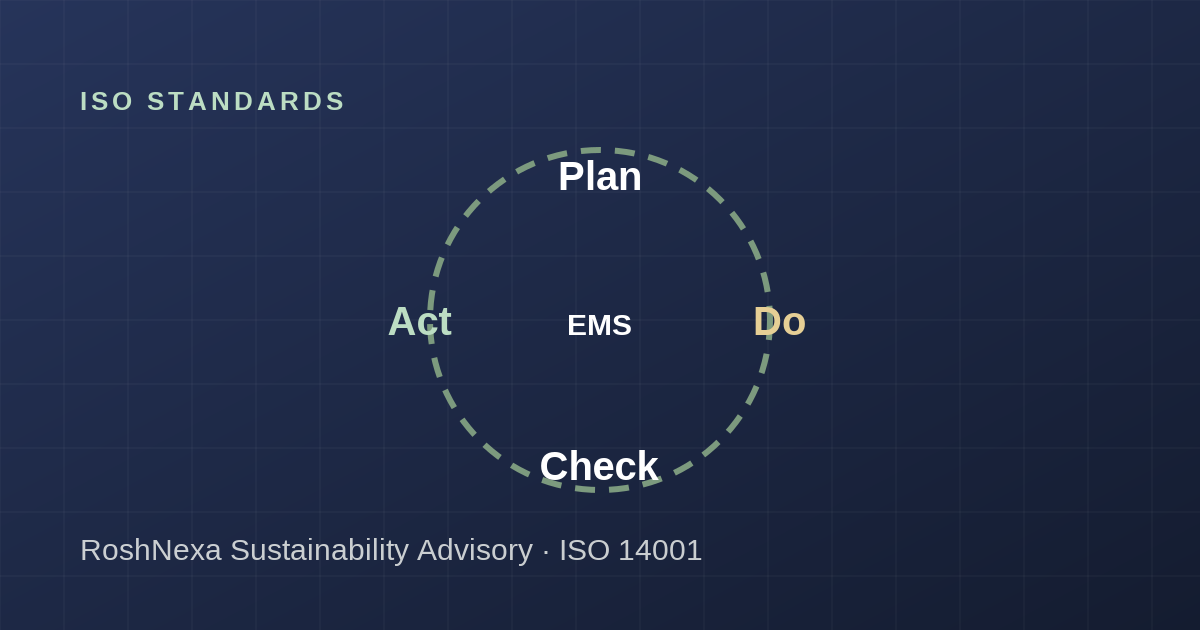
- The standard follows the Plan-Do-Check-Act cycle, with requirements set out in clauses 4 to 10.
- Its core building blocks are environmental aspects, compliance obligations, objectives, operational controls, internal audit and management review.
- A 2024 amendment requires organizations to consider whether climate change is a relevant issue for their EMS.
What is ISO 14001?
ISO 14001 is the international standard that sets requirements for an environmental management system (EMS). An EMS is the set of policies, processes and records an organization uses to manage its environmental responsibilities: understanding its environmental impacts, meeting legal requirements and improving performance over time. Any organization, of any size or sector, can use it, and organizations can be certified to it by accredited certification bodies.
The edition used for most certifications is ISO 14001:2015, amended in 2024 to address climate change. ISO revises its standards periodically, so check the ISO website for the latest edition.
How does ISO 14001 work?
ISO 14001 follows the Plan-Do-Check-Act (PDCA) cycle. Its requirements sit in clauses 4 to 10:
| Clause | Topic | What it means in practice |
|---|---|---|
| 4 | Context of the organization | Internal and external issues, interested parties and the scope of the EMS |
| 5 | Leadership | Top management commitment, environmental policy, roles and responsibilities |
| 6 | Planning | Environmental aspects, compliance obligations, risks and opportunities, objectives |
| 7 | Support | Resources, competence, awareness, communication and documented information |
| 8 | Operation | Operational controls, a life-cycle perspective and emergency preparedness |
| 9 | Performance evaluation | Monitoring and measurement, compliance evaluation, internal audit and management review |
| 10 | Improvement | Nonconformity, corrective action and continual improvement |
What are environmental aspects and impacts?
An environmental aspect is an element of the organization’s activities, products or services that interacts with the environment, such as diesel combustion in generators or wastewater discharge from a site. An environmental impact is the resulting change to the environment, such as air pollution or water contamination. The organization identifies its aspects, decides which are significant using defined criteria and plans controls for them.
What are compliance obligations?
Compliance obligations are the legal requirements an organization must meet and the other requirements it chooses to adopt, such as client or industry commitments. They are usually tracked in a legal register, and the standard requires the organization to evaluate its compliance at planned intervals.
What changed in 2024?
In February 2024, ISO amended ISO 14001 and many other management system standards to address climate change. Organizations must now determine whether climate change is a relevant issue when they consider their context (clause 4.1), and a note in clause 4.2 recognizes that interested parties can have requirements related to climate change.
How does ISO 14001 certification work?
Certification is carried out by an independent certification body, ideally one accredited by a recognized accreditation body. It normally involves a stage 1 audit, which reviews documentation and readiness, and a stage 2 audit, which checks that the system is implemented and effective. Certificates are typically valid for three years, with surveillance audits during that period and a recertification audit at the end.
How does ISO 14001 relate to other standards?
ISO management system standards share a common high-level structure, so ISO 14001 can be integrated with ISO 9001 for quality, ISO 45001 for occupational health and safety and ISO 50001 for energy, sharing documentation, internal audits and management reviews. An EMS can also provide the processes behind a greenhouse gas inventory prepared under ISO 14064-1.
How do you get started?
- Run a gap assessment against the standard.
- Define the scope and context of the EMS.
- Build the aspects and impacts register and the legal register.
- Set objectives, KPIs and operational controls for significant aspects.
- Train staff and assign responsibilities.
- Carry out an internal audit and a management review.
- Select an accredited certification body and schedule the certification audits.
RoshNexa supports ISO 14001 and integrated management systems, from gap assessment to certification readiness.
References
- ISO: ISO 14001 Environmental management systems
- ISO 14001:2015, Environmental management systems: requirements with guidance for use
- ISO 14001
- Environmental management system
- EMS
- Certification
- Compliance