Key takeaways
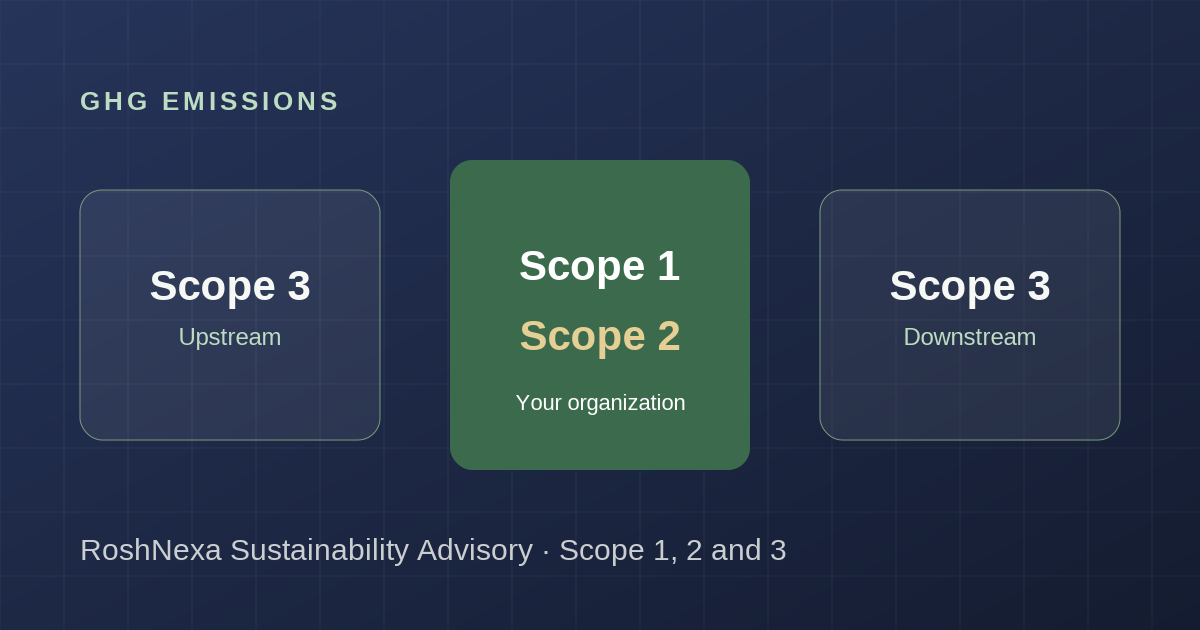
- Scope 1 is direct emissions from sources you own or control; Scope 2 is indirect emissions from purchased energy; Scope 3 is every other indirect emission in your value chain.
- The GHG Protocol Scope 2 Guidance asks companies to report Scope 2 in two ways: location-based and market-based.
- Scope 3 has 15 categories, eight upstream and seven downstream, and for many organizations it is the largest share of the footprint.
- The same emission can be one company’s Scope 1 and another company’s Scope 3, which is why clear boundaries matter.
What are Scope 1, 2 and 3 emissions?
Scope 1, 2 and 3 are the three categories the Greenhouse Gas (GHG) Protocol uses to classify an organization’s emissions. Scope 1 covers direct emissions from sources the organization owns or controls. Scope 2 covers indirect emissions from the generation of electricity, steam, heat and cooling that the organization buys. Scope 3 covers all other indirect emissions that occur in its value chain, upstream and downstream.
The distinction matters because each scope is measured with different data, managed with different levers and reported under different rules. A clear split also prevents the same emission from being counted twice in one inventory.
| Scope | What it covers | Typical examples |
|---|---|---|
| Scope 1 | Direct emissions from owned or controlled sources | Diesel in site generators, fuel in company vehicles and plant, gas in boilers, refrigerant leaks from chillers |
| Scope 2 | Indirect emissions from purchased energy | Grid electricity, district cooling, purchased steam or heat |
| Scope 3 | All other indirect value-chain emissions | Purchased steel and concrete, freight by third-party carriers, business travel, waste, use of sold products |
What counts as Scope 1?
Scope 1 includes four main source types:
- Stationary combustion: fuel burned in boilers, furnaces and generators.
- Mobile combustion: fuel used by company-owned or controlled vehicles, plant and equipment.
- Process emissions: emissions released by chemical or physical processes, such as the calcination of limestone in cement production.
- Fugitive emissions: unintended releases, most commonly refrigerant leaks from air-conditioning and chiller systems.
Refrigerants are easy to overlook, but many refrigerant gases have a high global warming potential, so even small top-ups can be material. Under the GHG Protocol, carbon dioxide from burning biomass is reported separately rather than inside the scopes.
What counts as Scope 2?
Scope 2 covers the emissions from generating the electricity, steam, heat and cooling an organization purchases and consumes. In the Gulf region, district cooling is a common Scope 2 source alongside grid electricity.
The GHG Protocol Scope 2 Guidance asks companies to report Scope 2 in two ways:
- Location-based: uses average emission factors for the grid where the energy is consumed.
- Market-based: uses factors from the contracts and instruments the company has chosen, such as supplier-specific factors, power purchase agreements or energy attribute certificates that meet the guidance’s quality criteria.
Reporting both, often called dual reporting, shows the effect of the grid and the effect of purchasing decisions separately.
What counts as Scope 3?
Scope 3 covers every other indirect emission in the value chain. The GHG Protocol Corporate Value Chain (Scope 3) Standard divides it into 15 categories:
| Upstream | Downstream |
|---|---|
| 1. Purchased goods and services | 9. Downstream transportation and distribution |
| 2. Capital goods | 10. Processing of sold products |
| 3. Fuel- and energy-related activities not included in Scope 1 or 2 | 11. Use of sold products |
| 4. Upstream transportation and distribution | 12. End-of-life treatment of sold products |
| 5. Waste generated in operations | 13. Downstream leased assets |
| 6. Business travel | 14. Franchises |
| 7. Employee commuting | 15. Investments |
| 8. Upstream leased assets |
Which categories dominate depends on the business model. For a contractor, purchased materials such as steel and concrete (category 1) often outweigh everything else. For a manufacturer of energy-using products, the use of sold products (category 11) can be the largest category. Screening all 15 categories for relevance and size is the usual first step.
Why can one emission appear in different scopes?
Scopes are defined from the point of view of the reporting company. The emissions from a power plant are the utility’s Scope 1, its customers’ Scope 2, and part of their suppliers’ and customers’ Scope 3. This overlap between companies is expected. Within a single inventory, however, each emission should be counted once, which is why clear organizational and operational boundaries come first.
How do the scopes relate to ISO 14064-1 categories?
ISO 14064-1:2018 classifies emissions into six categories instead of three scopes. The two systems map closely, although not one-to-one in every detail:
| GHG Protocol | ISO 14064-1:2018 |
|---|---|
| Scope 1 | Category 1: direct GHG emissions and removals |
| Scope 2 | Category 2: indirect emissions from imported energy |
| Scope 3 | Categories 3 to 6: indirect emissions from transportation, products used by the organization, use of products from the organization, and other sources |
What are the most common mistakes?
- Leaving out refrigerant leaks from Scope 1.
- Reporting only one Scope 2 method when the reporting framework expects both.
- Excluding Scope 3 categories without documenting the screening and the reason.
- Counting fuel combustion in Scope 1 and again in Scope 3 category 3. Category 3 covers only the upstream emissions of producing and delivering fuels and energy.
- Mixing emission factors from different sources and years without recording which was used.
- Changing boundaries after an acquisition or divestment without recalculating the base year.
How should an organization start?
- Choose an organizational boundary: the equity share, financial control or operational control approach.
- List Scope 1 and Scope 2 sources for every site and asset inside the boundary.
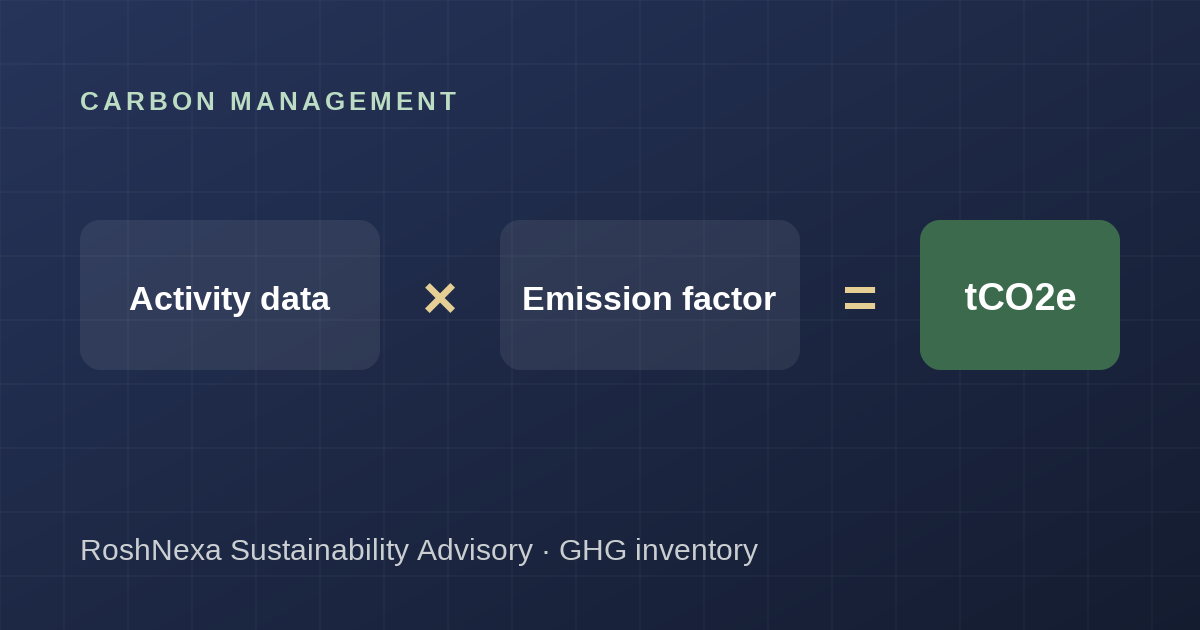
- Collect a full year of activity data, such as fuel records, meter readings and invoices.
- Select emission factors and record their source, year and units.
- Screen all 15 Scope 3 categories for relevance and approximate size.
- Calculate, check and document the results, then decide whether to seek independent verification.
A clear split between the scopes is what makes targets, disclosures and reduction plans comparable from year to year. If you are building your first inventory, our GHG accounting and carbon inventory service covers boundaries, factors and verification support.
References
- GHG Protocol: Corporate Accounting and Reporting Standard (Revised Edition)
- GHG Protocol: Scope 2 Guidance
- GHG Protocol: Corporate Value Chain (Scope 3) Standard
- ISO 14064-1:2018, Greenhouse gases, Part 1
- Scope 1
- Scope 2
- Scope 3
- GHG Protocol
- ISO 14064-1