
Strategy & Disclosure · Service 02
Double Materiality & Stakeholder Engagement
Identify the topics that matter by impact and by financial effect. Double materiality looks at sustainability topics from two directions: the impact your organization has on people and the environment, and the financial effect sustainability matters have on your organization. We run the assessment end to end, from stakeholder engagement to a board-ready material topics register.
- 5core capabilities
- 5phase delivery approach
- 3key deliverables
- 4standards & frameworks
Overview
What is a double materiality assessment?
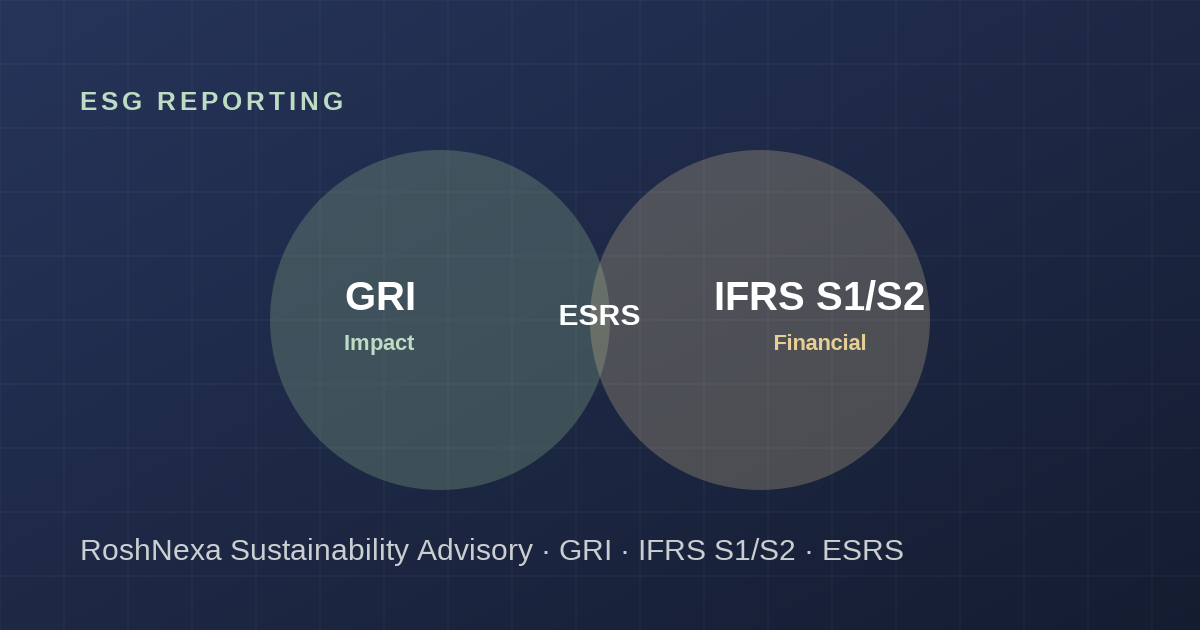
A double materiality assessment identifies which sustainability topics are material from an impact perspective (the organization’s effects on people and the environment) and from a financial perspective (risks and opportunities that affect the organization’s performance or value). A topic is material if it meets either test. The concept is central to the EU’s European Sustainability Reporting Standards (ESRS).
Who this is for
- Companies preparing for CSRD / ESRS or other double-materiality based reporting
- Organisations refreshing a GRI materiality assessment
- Businesses that need defensible evidence for why topics were included or excluded
Business benefits
- A documented, defensible basis for what your report covers and what it leaves out
- Input to strategy, risk management and target setting
- Evidence of stakeholder engagement that reviewers and rating agencies look for
- One assessment structured to inform GRI, IFRS and ESRS-style reporting
Capabilities
What we deliver
Stakeholder mapping
Identification and prioritisation of internal and external stakeholders across the value chain.
Topic universe
A long list of topics built from sector context, ESRS, GRI and SASB standards and peer reports.
Impact materiality scoring
Actual and potential impacts scored on scale, scope, remediability and likelihood.
Financial materiality scoring
Risks and opportunities scored on likelihood and magnitude of financial effect.
Validated matrix
Management validation workshop and a documented, auditable materiality matrix and topic register.
Implementation approach
How the engagement runs
- 01
Context
Business model, value chain and sector context reviewed to frame the assessment.
Output: Value-chain map - 02
Engage
Stakeholder surveys and interviews designed and run with internal and external groups.
Output: Stakeholder input log - 03
Identify
Impacts, risks and opportunities (IROs) listed for each candidate topic.
Output: IRO long list - 04
Score
Impact and financial materiality scored with documented thresholds.
Output: Scoring model - 05
Validate
Results reviewed with management and approved, with rationale recorded.
Output: Materiality matrix and report
Ready to plan your Double Materiality work?
Book a free scoping session. We agree scope, inputs and timeline before any work starts.
Scope & deliverables
Full scope of work
Scope
- Stakeholder mapping and prioritization
- Survey design and interview guides for internal and external stakeholders
- A long list of topics drawn from sector context, reporting standards and peers
- Impact scoring (scale, scope, remediability and likelihood) and financial scoring (likelihood and magnitude)
- Validation workshop with management and a documented materiality matrix
Key deliverables
- Stakeholder mapping, surveys and interview guides
- Impact and financial materiality scoring model and matrix
- Material topics register and board-ready report
Standards followed
Frameworks and methodologies applied
The EU Corporate Sustainability Reporting Directive and its European Sustainability Reporting Standards, built on double materiality.
GRI 3 guidance for identifying and managing the topics that reflect an organisation's most significant impacts.
Financial materiality as defined by the ISSB: information that could reasonably affect investors' decisions.
International guidelines for risk management, used to score, treat and monitor risks consistently.
Working together
What we need from you
- Business model and value-chain overview
- Stakeholder contact lists for surveys and interviews
- Existing risk register and any previous materiality work
- Management availability for the validation workshop
Experience
Delivered in practice
Double Materiality Assessment (DMA)
Stakeholder and value-chain mapping, impact, risk and opportunity identification, impact and financial scoring, and a validated materiality matrix.
FAQ
Frequently asked questions
How is double materiality different from GRI materiality?
GRI focuses on impact materiality: the organization’s most significant impacts on the economy, environment and people. IFRS S1 focuses on financial materiality for investors. Double materiality combines both perspectives, as required under the ESRS.
Who should take part in the assessment?
Internal functions such as operations, finance, HR, procurement and risk, plus external stakeholders such as clients, employees, suppliers, investors and communities, selected through stakeholder mapping.
Is a double materiality assessment required for CSRD?
Yes. Under the ESRS, the double materiality assessment determines which topics and disclosures a company must report.
Can the assessment be reused for GRI reporting?
Yes. The impact materiality side aligns with GRI 3, so one well-documented assessment can support both GRI and ESRS-based reporting.
Explore more
Related services
ESG Strategy, Gap Assessment & Roadmap
Build the ESG operating model before reporting begins.
Learn more →03GRI Sustainability Reporting
A structured report with traceable disclosures and evidence.
Learn more →04IFRS S1 / S2 & ISSB Reporting
Investor-grade sustainability and climate disclosures.
Learn more →Ready to take your sustainability from ambition to assurance?
The first scoping conversation is free.