Key takeaways
- ESG reporting discloses environmental, social and governance information to investors, clients, regulators and other stakeholders.
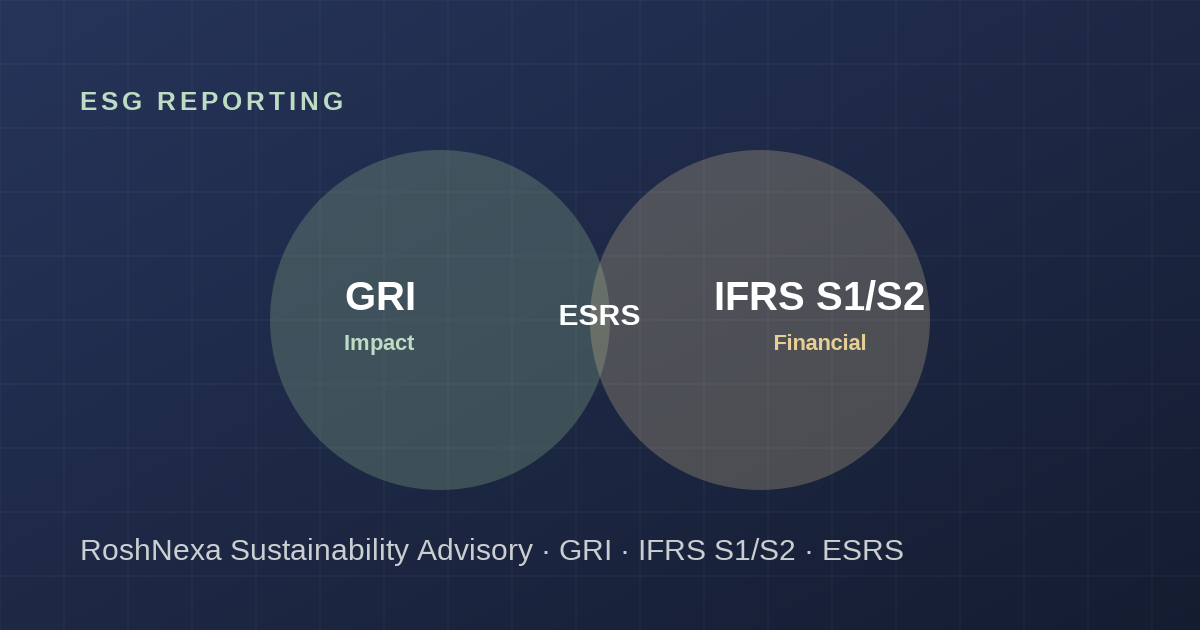
- GRI focuses on an organization’s impacts on the economy, environment and people; IFRS S1 and S2 focus on sustainability-related risks and opportunities that affect enterprise value.
- The EU’s European Sustainability Reporting Standards (ESRS) use double materiality, combining both perspectives.
- The frameworks can be used together; one shared data foundation avoids reporting the same numbers three different ways.
What is ESG reporting?
ESG reporting is the disclosure of an organization’s environmental, social and governance information: its policies, performance, targets, risks and impacts. Reports are read by investors and lenders, clients running supplier assessments, regulators and employees. A good report explains not only what the organization did, but which topics matter most, how they are governed and how progress is measured.
Which ESG reporting frameworks matter most?
GRI Standards
The Global Reporting Initiative (GRI) Standards are the most widely used framework for reporting an organization’s impacts. They consist of the Universal Standards (GRI 1 Foundation, GRI 2 General Disclosures and GRI 3 Material Topics), Sector Standards and Topic Standards such as GRI 305 on emissions. A GRI report includes a content index that shows where each disclosure can be found.
IFRS S1 and IFRS S2
The International Sustainability Standards Board (ISSB) issued IFRS S1 and IFRS S2 in June 2023, effective for annual periods beginning on or after 1 January 2024 where they are adopted. IFRS S1 sets general requirements for disclosing sustainability-related risks and opportunities; IFRS S2 covers climate, including Scope 1, 2 and 3 greenhouse gas emissions. Both are organized around four pillars: governance, strategy, risk management, and metrics and targets. IFRS S2 incorporates the recommendations of the Task Force on Climate-related Financial Disclosures (TCFD), which disbanded in 2023.
European Sustainability Reporting Standards (ESRS)
The ESRS were adopted by the European Commission in 2023 for companies within the scope of the EU Corporate Sustainability Reporting Directive (CSRD). They are built on double materiality and cover environmental, social and governance topics, including ESRS E1 on climate change. The EU has since taken steps to simplify the requirements and change their scope and timing, so companies should check the current position for their situation.
| Framework | Primary audience | Materiality lens | Status |
|---|---|---|---|
| GRI Standards | Broad stakeholders | Impact materiality | Voluntary, widely used worldwide |
| IFRS S1 and S2 | Investors and other capital providers | Financial materiality (enterprise value) | Adopted jurisdiction by jurisdiction |
| ESRS | Investors and wider stakeholders in the EU | Double materiality | Mandatory for in-scope companies under the CSRD |
What is the difference between impact and financial materiality?
Impact materiality asks how the organization affects the economy, environment and people, for example through its emissions or working conditions in its supply chain. Financial materiality asks how sustainability matters affect the organization’s cash flows, access to finance or cost of capital, for example through carbon pricing or physical climate risk. Double materiality treats a topic as material if it meets either test.
Is ESG reporting mandatory?
It depends on where the organization is listed, where it operates and who it sells to. Requirements come from three directions:
- Regulation: jurisdictions adopting IFRS S1 and S2, and the EU’s CSRD for in-scope companies.
- Capital markets: stock exchanges in the region, including Dubai Financial Market, Abu Dhabi Securities Exchange and Saudi Exchange, have published ESG disclosure guidance for listed companies.
- Customers and supply chains: supplier ratings such as EcoVadis, client questionnaires and EU importers’ CBAM data requests often require ESG information even where no law does.
How should a company start ESG reporting?
- Identify who will read the report and which obligations or requests apply.
- Run a materiality assessment to decide which topics to report on.
- Assess gaps between current data and the chosen framework’s requirements.
- Build the data foundation: owners, sources, calculation methods and controls for each indicator.
- Publish a first report, for example with reference to the GRI Standards, and plan IFRS readiness where investors require it.
- Decide when to seek external assurance.
What does a good ESG report contain?
A clear description of governance and strategy, the material topics and how they were chosen, KPIs with the methods behind them, targets and progress, multi-year data tables, a content index linking to the framework, and an assurance statement where one has been obtained.
RoshNexa supports GRI reporting, IFRS S1 and S2 readiness and double materiality assessments.
References
- Global Reporting Initiative: GRI Standards
- IFRS Foundation: IFRS S1 General Requirements for Disclosure of Sustainability-related Financial Information
- IFRS Foundation: IFRS S2 Climate-related Disclosures
- European Commission: Corporate sustainability reporting
- EFRAG: Sustainability reporting
- ESG reporting
- GRI
- IFRS S1
- IFRS S2
- ISSB
- ESRS
- Materiality