Key takeaways
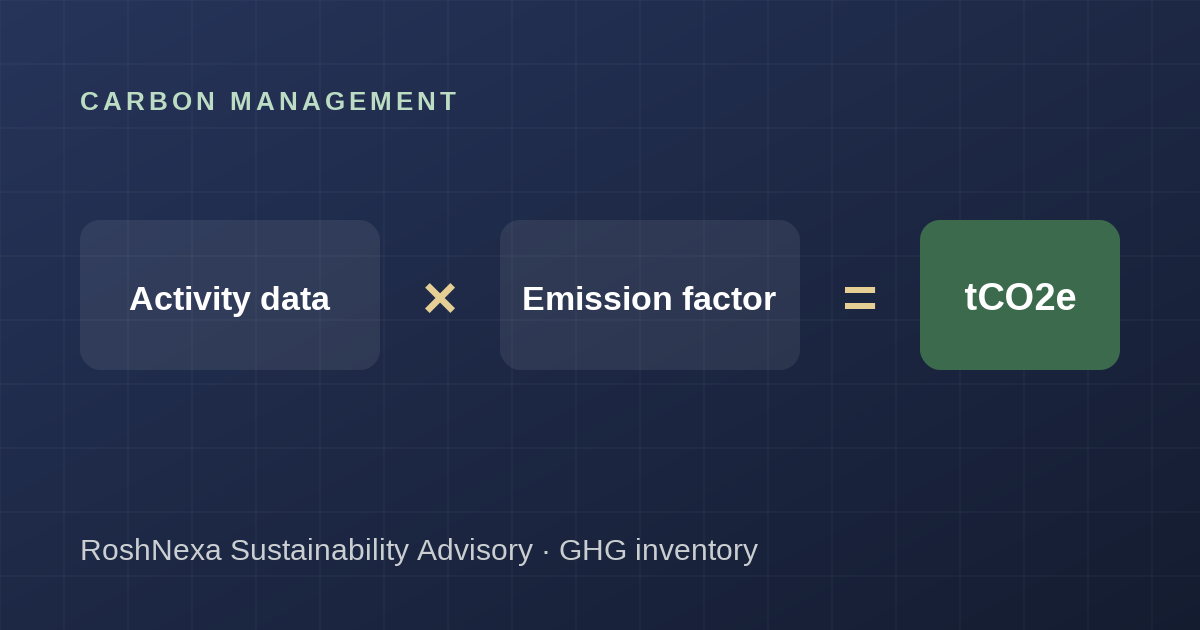
- The core formula is activity data × emission factor = emissions, expressed in tonnes of CO2-equivalent (tCO2e).
- Boundaries come first: decide the consolidation approach and which sources are included before collecting data.
- Emission factors must be recorded with their source, year and units; many calculation errors come from unit mismatches and outdated factors.
- A verification-ready inventory documents every assumption, so a verifier can follow the trail from source data to the reported total.
What is a greenhouse gas inventory?
A greenhouse gas (GHG) inventory is a structured account of the greenhouse gases an organization emits over a reporting period, usually one year. The GHG Protocol covers seven gases: carbon dioxide, methane, nitrous oxide, hydrofluorocarbons, perfluorocarbons, sulphur hexafluoride and nitrogen trifluoride. Results are expressed in tonnes of CO2-equivalent (tCO2e), using global warming potentials (GWPs) published by the IPCC to convert each gas to the warming effect of carbon dioxide.
Is a carbon footprint the same as a GHG inventory?
The terms are often used interchangeably for organizations. Strictly, the inventory is the full record (boundaries, data, factors, methods and results) and the carbon footprint is the headline total. “Carbon footprint” is also used for products, which follow a different method, such as ISO 14067.
How is a carbon footprint calculated?
The core calculation is simple:
Activity data × emission factor = emissions (tCO2e)
Activity data measures an activity, such as litres of diesel burned or kilowatt-hours of electricity bought. An emission factor converts that activity into emissions. The illustrative example below uses round-number factors; real inventories must use current factors from a documented source.
| Source | Activity data | Illustrative factor | Emissions |
|---|---|---|---|
| Diesel in site generators (Scope 1) | 50,000 litres | 2.7 kg CO2e per litre | 135 tCO2e |
| Grid electricity (Scope 2, location-based) | 1,200,000 kWh | 0.4 kg CO2e per kWh | 480 tCO2e |
Every line in an inventory follows the same logic. The difficulty is not the arithmetic; it is choosing the right boundaries, data and factors, and documenting them.
What are the steps to build a GHG inventory?
1. Set the organizational boundary
Decide which entities and facilities are included, using one of the GHG Protocol consolidation approaches: equity share, financial control or operational control. Apply the same approach to all operations.
2. Set the operational boundary
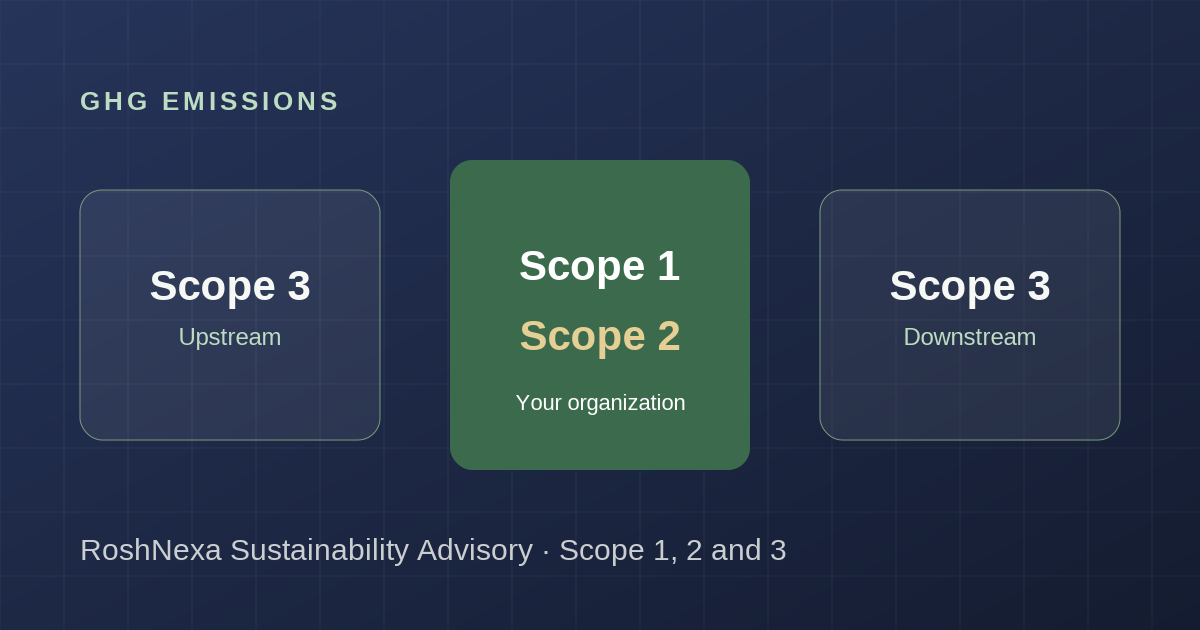
Identify the emission sources inside that boundary and classify them as Scope 1, Scope 2 or Scope 3. Screen all 15 Scope 3 categories and document which are included and why.
3. Choose a base year
The base year is the reference point for targets and trends. Set a recalculation policy so the base year is restated after significant changes, such as acquisitions, divestments or corrected methods.
4. Collect activity data
Use the most direct records available: fuel logs, meter readings, utility invoices, refrigerant service records, travel bookings and procurement data. Physical units, such as litres and kilowatt-hours, are more accurate than spend.
5. Select emission factors
Typical sources include the IPCC, national inventories, the UK Government GHG conversion factors, grid factors from energy authorities and supplier-specific data. Record the source, version, year and units of every factor.
6. Calculate and check quality
Run the calculations, then check units, completeness by site and month, year-on-year variances and a sample of recalculations. Grade data quality, so weak estimates are visible and can be improved.
7. Document, report and verify
Prepare an inventory report that states boundaries, methods, factors, assumptions and exclusions. If the results will be disclosed or used for targets, consider independent verification, for example under ISO 14064-3 at a limited or reasonable level of assurance.
What data quality problems are most common?
- Unit mismatches, such as kWh recorded as MWh or cubic metres recorded as litres.
- Missing months filled by estimates without a documented method.
- Factors from different years or sources mixed without a record.
- Spend-based factors applied in the wrong currency or price year.
- Refrigerant top-ups left out because they sit in maintenance records, not energy bills.
What makes an inventory verification-ready?
A verifier needs to follow the trail from each reported figure back to its source. In practice that means a complete data trail, a factor register, documented assumptions and exclusions, a QA/QC log, consistent boundaries across years and management sign-off. Building these from the start costs far less than reconstructing them before an audit.
For support with boundaries, factor libraries and verification packs, see our GHG accounting and carbon inventory service. For the difference between the three scopes, read Scope 1, 2 and 3 emissions: what is the difference?
References
- GHG Protocol: Corporate Accounting and Reporting Standard (Revised Edition)
- ISO 14064-1:2018, Greenhouse gases, Part 1
- ISO 14064-3:2019, Greenhouse gases, Part 3: verification and validation
- UK Government: Greenhouse gas conversion factors for company reporting
- IPCC Emission Factor Database
- GHG inventory
- Carbon footprint
- Emission factors
- GHG Protocol
- ISO 14064-1
- Verification