
Carbon & Climate · Service 06
GHG Accounting & Carbon Inventory
An auditable Scope 1, 2 and 3 inventory built from raw operational data. A greenhouse gas inventory is the starting point for every carbon target, disclosure and reduction plan. We build yours from raw operational data, with documented boundaries, emission factors and quality checks, so it can stand up to third-party verification.
- 5core capabilities
- 5phase delivery approach
- 3key deliverables
- 4standards & frameworks
Overview
What is a greenhouse gas (GHG) inventory?
A GHG inventory is a structured account of an organization’s greenhouse gas emissions over a reporting period, usually a year. It sets organizational and operational boundaries, converts activity data such as fuel, electricity and purchased goods into tonnes of CO2-equivalent using emission factors, and reports results by Scope 1, 2 and 3 under the GHG Protocol, or by category under ISO 14064-1.
Who this is for
- Companies calculating their first carbon footprint
- Organisations preparing for third-party verification under ISO 14064-3
- Suppliers asked by clients for Scope 1, 2 and 3 data
Business benefits
- A baseline you can set targets against and report from
- Documentation that answers verifier questions on boundaries, factors and assumptions
- Visibility of emissions hotspots across operations and the value chain
- Data that can be reused for GRI 305, IFRS S2 and client questionnaires
Capabilities
What we deliver
Boundary setting
Organisational boundary (equity share or control) and operational boundary defined and documented.
Scope 3 screening
All 15 Scope 3 categories screened for relevance and data availability.
Data collection system
Activity data templates for each emission source, with owners and evidence references.
Emission factor library
Factors from sources such as IPCC and DEFRA, with versions and sources recorded.
Verification-ready calculations
Location- and market-based Scope 2, data-quality grading, QA/QC checks and a verification pack.
Implementation approach
How the engagement runs
- 01
Boundary
Entities, sites, base year and reporting period agreed.
Output: Boundary document - 02
Collect
Activity data gathered through templates and validated with site teams.
Output: Activity data set - 03
Calculate
Emissions calculated with documented factors and methods.
Output: Calculation workbook - 04
Check
QA/QC, uncertainty and data-quality grading performed.
Output: QA/QC log - 05
Report
Inventory report and verification support pack prepared.
Output: GHG inventory report
Ready to plan your GHG Accounting work?
Book a free scoping session. We agree scope, inputs and timeline before any work starts.
Scope & deliverables
Full scope of work
Scope
- Organizational boundary using the equity share or control approach
- Operational boundary, base year and screening of the 15 Scope 3 categories
- Activity data collection templates for each emission source
- Emission factor library (for example IPCC and DEFRA) with sources and versions recorded
- Calculations, including location-based and market-based Scope 2, data-quality grading and QA/QC checks
- Inventory report and a verification support pack
Key deliverables
- Boundary assessment, base year and Scope 1-3 category screening
- Emission factor library, calculation method and data-quality grading
- QA/QC checks and third-party verification support pack
Standards followed
Frameworks and methodologies applied
The global standard for measuring and reporting Scope 1, 2 and 3 greenhouse gas emissions.
Part 1 organisation inventories, Part 2 projects, and Part 3 validation and verification of GHG statements.
Recognised emission factor sources: IPCC guidelines and the UK Government (DESNZ/DEFRA) conversion factors.
International standard for carbon neutrality claims, covering reductions first and the credible use of offsets.
Working together
What we need from you
- Fuel, electricity, refrigerant and fleet records
- Procurement, logistics, travel and waste data
- List of entities, sites and ownership structure
- A named contact at each site
Experience
Delivered in practice
GHG Accounting & Carbon Inventory
Boundary definition, activity data, emission factors, Scope 1-3 calculations, QA/QC and verification-ready files.
FAQ
Frequently asked questions
What is the difference between Scope 1, 2 and 3 emissions?
Scope 1 covers direct emissions from sources the organization owns or controls, such as fuel burned in boilers and vehicles. Scope 2 covers indirect emissions from purchased electricity, steam, heat and cooling. Scope 3 covers all other indirect emissions in the value chain, across 15 categories from purchased goods to the use of sold products.
Can the inventory be independently verified?
Yes. We prepare a verification support pack with methods, factors, data trails and QA/QC records so an independent verifier can assess the inventory, for example under ISO 14064-3.
Which year should be the base year?
Usually the most recent year with reliable data. The base year policy also defines when the base year must be recalculated, for example after acquisitions.
Can you calculate product carbon footprints too?
The core service is the corporate inventory. Product-level footprints and embedded emissions (for example for CBAM) are covered under related services.
Insights
Related insights
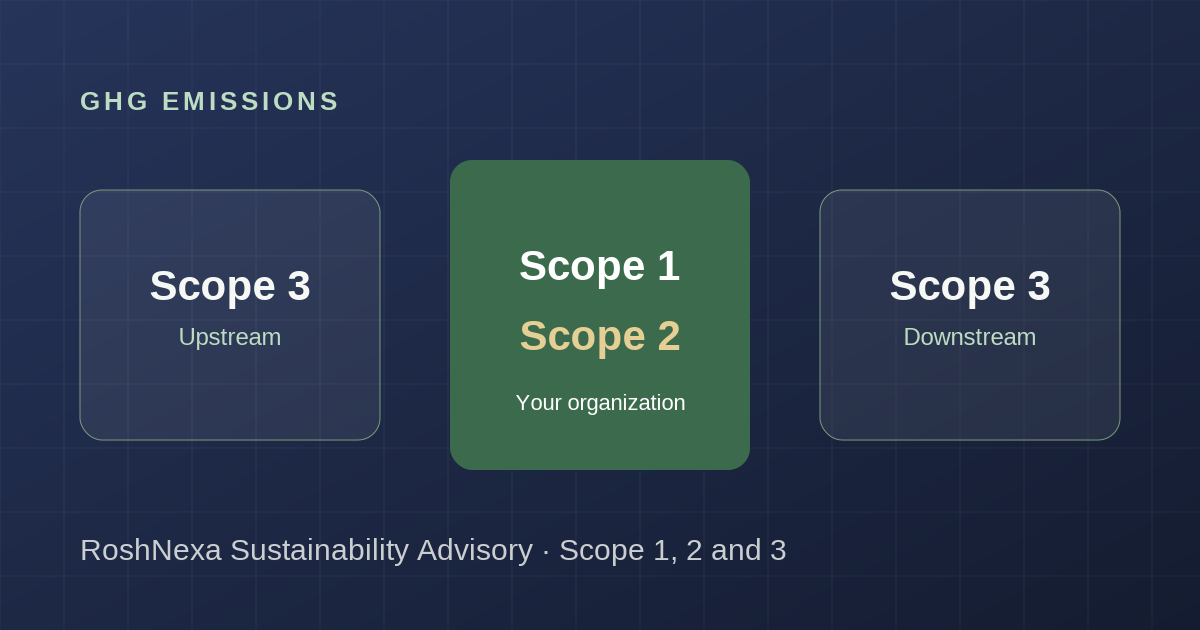 GHG Emissions
Scope 1, 2 and 3 emissions: what is the difference?
Scope 1, 2 and 3 are the three categories the GHG Protocol uses to classify an organization’s greenhouse gas emissions. This guide explains each scope with practical examples, lists the 15 Scope 3 categories and covers the mistakes that most often weaken an inventory.
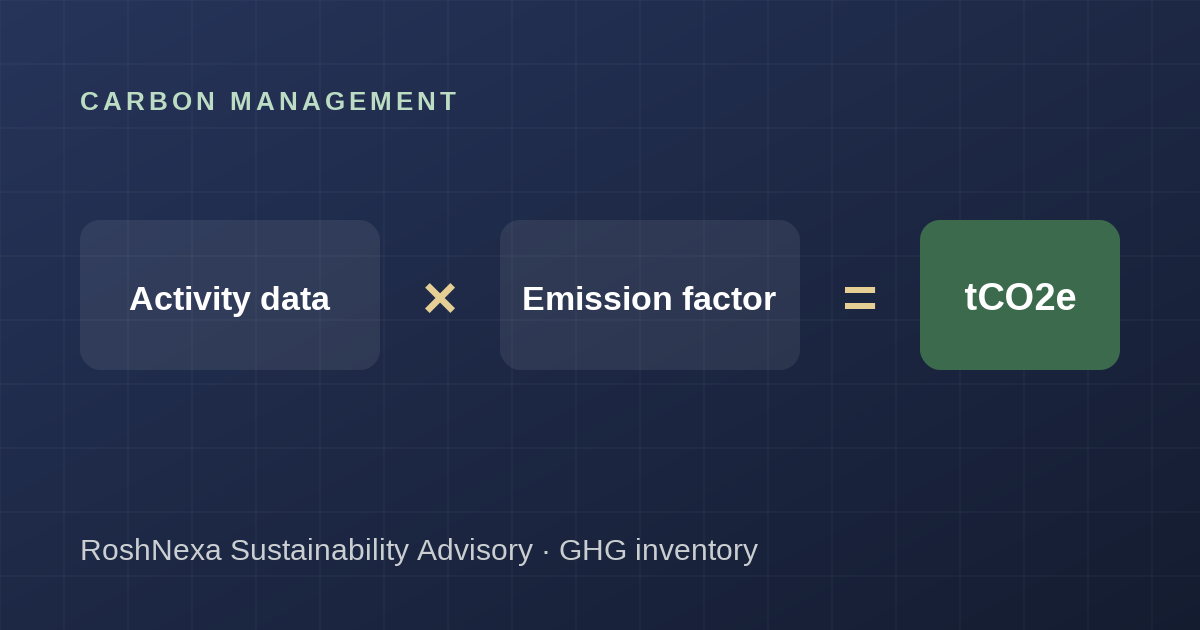 Carbon Management
What is a greenhouse gas inventory, and how is a corporate carbon footprint calculated?
A corporate carbon footprint is calculated by multiplying activity data by emission factors, within clearly defined boundaries. This guide walks through the steps of building a greenhouse gas inventory that can stand up to verification.
Explore more
Related services
Decarbonization & Net-Zero Strategy
The carbon baseline converted into targets and practical reduction actions.
Learn more →15CBAM Readiness & Embedded Emissions Reporting
Carbon data EU customers can use in their CBAM declarations.
Learn more →13ESG Data Systems, Dashboards & Digital Sustainability
Reporting requirements turned into a client-owned data and monitoring system.
Learn more →Ready to take your sustainability from ambition to assurance?
The first scoping conversation is free.